The Beginning
AI = Artificial Intelligence
Preamble
AI growth has been significant over the last couple of years. So much so that it’s time to talk about the cultural effects, not just the digital. There is a lot of skepticism around it all. Some say this is just an AI bubble. Something akin to that of the dot-com bubble. An over-hype based on subjectivity. Others believe this is a transformational shift in our lifetimes, much like the Industrial Revolution. Many claim that we are on the precipice of a new world. What this new world looks like, we can only imagine.
There is a race to become the leader in AI between the major powers of the world. We live in a world driven by wealth and power. World leaders are blinded by an exclusive focus on wealth-driven leadership. That is a flawed perspective in this new future world. NOW is the time. We must start to consider a future where wealth is in line with everything else and not at the top of the pyramid. Major technology leaders in the AI space have made some bold predictions. A common suggestion is that by the year 2036, the world will run on AI and potentially alongside robots that not only compete with human cognitive knowledge but surpass it. This term is coined as AGI, or Artificial General Intelligence. And the events that follow are called the Singularity. Singularity is the event at which artificial intelligence grows at an uncontrollable and exponential rate. At this point, the AI becomes so smart that it can improve its own code (recursive self-improvement) faster than humans can follow or control. Is this realistic? What does this mean?
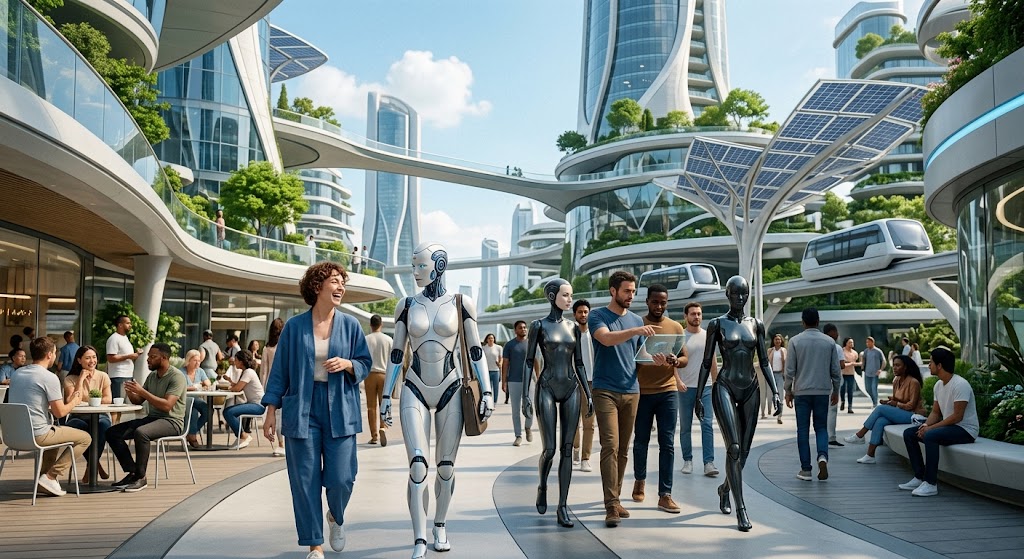
Elon Musk suggests that AI growth will be so significant that we as humans will experience a utopia. Other leading AI experts agree with him, although the timeline differs to some small extent. He leans on the basis that AI growth will create a world of abundance. He suggests that we will live in a world with humanoid robots (AI that work alongside humans) producing limitless food, housing, transport, and entertainment. The end of scarcity? Money becomes obsolete because supply will vastly outpace demand. Work becomes optional. Did I read that right? Work is OPTIONAL?!?
It really sounds fictional. At the same time, shouldn’t we probably believe the richest man in the world at the forefront of technology? Maybe you have something against Musk. That’s fine. Look around. You’ll find that many leaders in the AI space mimic the same sentiments as Musk. So what do we do? We need to talk about it. I’m going to start spitting some somewhat incoherent ramblings. Because this all seems so unrealistic. Particularly over the course of only 10-15 years, given it has taken us approximately 266 years (the Industrial Revolution) to get to where we are today. And now there is the possibility that we will accomplish, to some extent, what it took us to do in 266 years over the course of about 20 years.
I’ve grown up and have soaked in technology. I’m a millennial. I’ve worked in the IT sector. I’ve been the language barrier breaker between humans and computers. I’ve held roles as an IT Administrator, Project Manager, and Infrastructure Manager. Given that, being a millennial and a technology enthusiast, I’m conflicted. I can see it, but I can’t believe it. Still, let’s talk about the next 10-15 years.
The AI Revolution
What is going to determine if AI will become successful? Humans, for better or worse. What’s unclear is the timeline. Let’s talk about some of the factors.
The Datacenter Debate
The current debate is on the power that runs AI data centers. Datacenters are huge warehouses that run massive amounts of servers and networking equipment, operating on storage and compute. Compute ultimately being the intelligence and storage, being the memory banks from which intelligence will be derived. So far, we’ve been strictly speaking about the power of AI as a tool. The human debate is about the real-world resources required to power data centers. It has been said that our electric grid is not capable of serving the needs of data centers. Additionally, the current demand to cool the heat created by these data centers is for water. Additionally, there are other environmental effects to be concerned about, like noise, water contamination, and more. There are suggestions that we should simply build in outer space, Arctic areas, or even contain data centers on our ocean floors. Realistically, or rather pessimistically, I would argue that these ideas are not well thought out. It’s rather a simple fix to a complex problem and task.
Brighter Ideas
One idea being floated that has some promise is Small Modular Reactors (SMRs). SMRs are nuclear and emit zero carbon emissions, but face the same environmental concerns previously addressed. However, this is a more realistic approach, keeping the hardware physically closer to the planet’s surface and the geographically regional communities they will serve. There are also solar and geothermal options. Solar and geothermal use different techniques to create a liquid cooling loop, utilizing a thermodynamic process called absorption. To understand how that works, think of it like this: when water evaporates (turns from liquid into steam), it steals heat from everything around it. With an absorption machine, the exact same thing happens, but we use a trick to make it happen super fast. We put the water inside a magic vacuum tank where all the air has been sucked out. So, inside the machine, the water instantly flashes into cold vapor. As it does this, it steals all the heat out of the pipes connected to the hot data center servers, and thus, the servers get cooled down.
Early Abundance Challenges & The AI Matrix
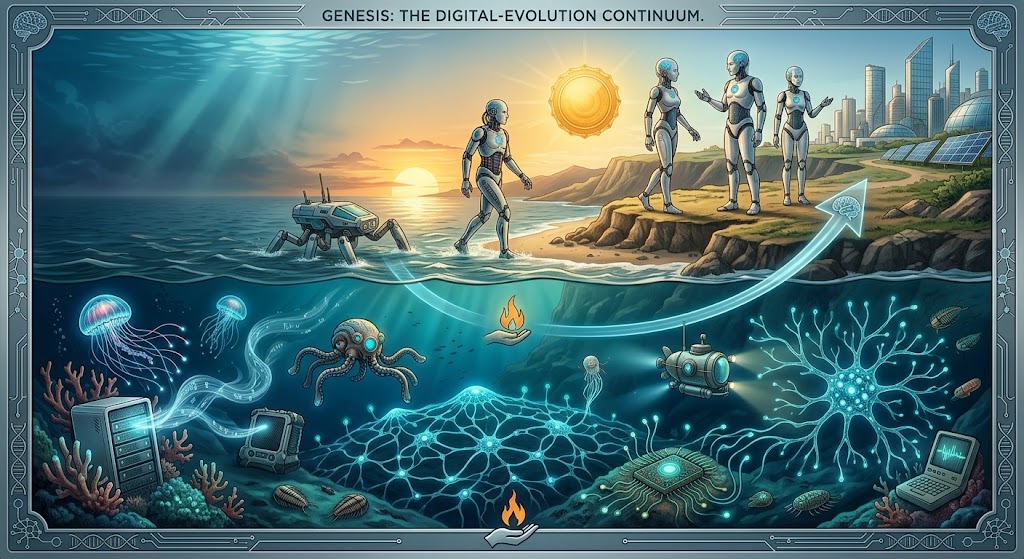
There is really just so much going on and so much to consider. One issue we’re looking at is the availability of compute resources. Datacenters are so popular that computing resources are not being developed at a capacity to withstand the pace of demand. Economics tells us that the price of these components goes up. So now consumers are experiencing issues acquiring computer components at home. So, with where we are we AI sort of lives in a digital matrix. Because we use computers, AI is making its presence known. But until we have developed robotics and machinery that can develop the abundance of resources Elon Musk spoke of in his utopia, AI still has some time to evolve from the ocean to land, so to speak. Consider that for a moment. How life on Earth evolved from the oceans to life on land. Using that metaphor, I’m suggesting that AI is currently at the state of life in the ocean. Once AI evolves as a “species” that roams the earth, we will still live in the world as we know it. AI data centers aren’t going to create abundance unless we are talking about an abundance of knowledge.
Closing
So that’s it. We are in the AI matrix. AI still lives inside a relatively immobile computer. Yes, robots exist and are being developed, but the merging of AI/Robot has yet to occur. Once that happens and robots start building things as humans do today, that’s when we’ll start to experience abundance. Robots don’t require sleep. They don’t have kids. They don’t get sick. Yes, they cost money, but at some point they build themselves given the abundance of resources they create. So, should we get comfortable with AI and robotics and how they will become an integral part of our lives? I say yes. Robots, as another being, if AI reaches Singularity, will become a part of the “human” race, and we will need to work side by side one day.